
Of the two primary types of capital, that which is invested with the expectation of a return, and that which is invested as philanthropic capital, with the aim of giving back, both have the potential of being purposeful. Typically, capital deployed with the intention of delivering returns is separated from capital deployed with some purposeful intention and is considered impact investing. The underlying assumption of impact investing is the investor has to forgo some returns to be able to "do good". The assumption is there is an inevitable trade-off.
Before we challenge any of these assumptions, let's first question what is means to be purposeful? It is defined as something done with clear intention, direction, or meaning. So, what is the direction worth directing capital towards? What if the purpose is solely to deliver return? In a recent study undertaken by Henmil Group Family Office, a global look at conventional opportunistic investing found the aggregate failure rate for conventional approaches to investing was 70%. Analysis included private equity, venture capital, mutual funds, mergers and acquisitions and large-scale change and digitization investments. Also included were conventional impact investing, green bonds, ESG funds and carbon projects. Let's consider if the purpose is to have an impact that makes the world a better place, what does that mean and how would one direct capital in a way that can deliver on it? What does making the world a better place look like?
First, some context about the evolution of human populations on the Earth. Since the advent of agriculture 10,000 years ago, a paradigm shift occurred. What was once a matrilineal system of deep relationship to the Earth, based in care and nurturing of the Earth, life systems and community — a stewardship system based inherently in indigenous culture — we gradually transitioned into a patriarchal system which dismantled the relationship to the Earth, elements, and life systems into one that coveted ownership, saw the Earth as a resource to be extracted from, and commoditised life systems as natural capital. Slow degradation of the Earth systems began to emerge which accelerated with colonisation and the discovery thesis propagated by the Church. From 1945, post-World War II, and the advent of globalisation, a rapid acceleration of degradation of life system saw us shift into a new epoch. Scientists call it the Great Anthropocene. This epoch was differentiated from previous epochs where human activity fundamentally alters ecological, climactic and atmospheric conditions, accelerating degradation at unprecedented rates. Population growth, coupled with shifts towards industrial and digital revolutions saw extraction at untenable rates. In 2019 alone, more mineral was mined from the Earth in that single year than all of the collective years prior since the dawn of humanity. With this acceleration we also saw significant increases in social inequality, demarcating the global North, those that have, from the Global South, those that have not. Despite this appearance of wealth, life was not all roses in affluent countries, with homelessness surpassing 700,000 people in the US alone, increasing political polarisation globally, increasing rates of violent crime, particularly against women and increasing food and water insecurity.
Life systems are teetering on collapse, with desertification occurring around the world at 1sqm per second, ocean acidification now passing the threshold of planetary boundaries, species extinction rates, including our pollinator species at unprecedented rates and global warming on track for a 3.2C increase, which scientists predicted will result in loss of 40% of the worlds oxygen. The OECD reported the longest and most intractable period of volatility since the 1960s which has impacted our investments. We are seeing this evident in enhanced systemic, structural and cyclical risks affecting our returns. When Henmil Group Family Office looked at conventional approaches to impact investing, green bonds, ESG Funds and Carbon projects, not only did they not deliver expected returns in 70% of cases, but they did also not deliver any systemic impact that was evident in our climate and social data. The failures of philanthropy and conventional impact investing is largely because they focus on single sectors and causes, much like the siloed and sector specific focus of opportunistic investing.
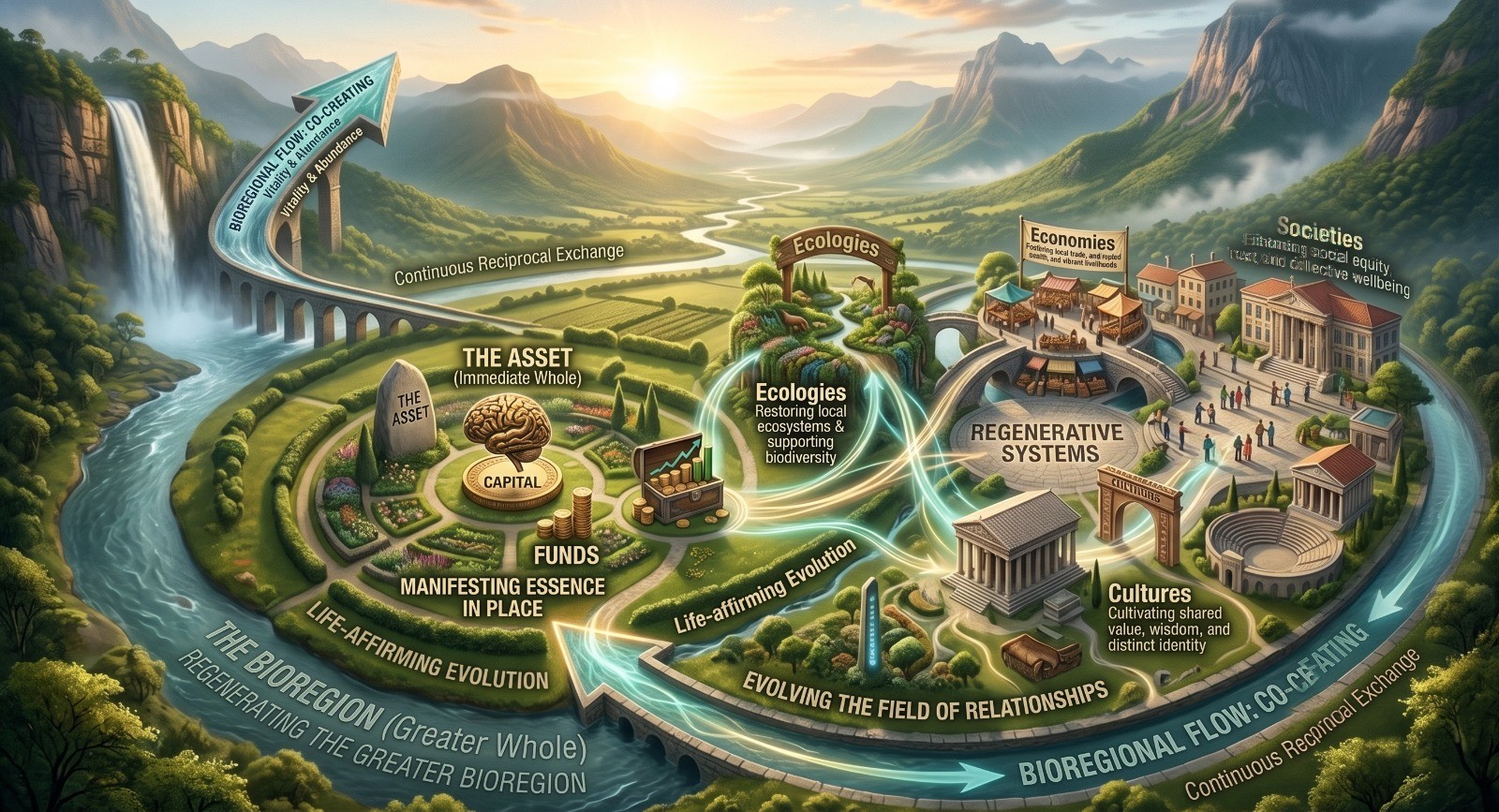
The alternative which has proven, in Henmil's research, is a regenerative or living-systems approach to asset, portfolio and project design. Regeneration works from living systems principle's and is a shift away from problem / solution thinking, which isolates challenges into single problems, removing them from their living systems context and the complexity of the system that gives rise to the problem in the first place. This problem / solution mindset is akin to chipping away at the top of an iceberg, whilst ignoring the deep larger mass of ice under the ocean which is the source of the ice we see above the water.
Across different asset classes, including real estate, infrastructure, commodities and direct investments explored over a 30-year period, Henmil found that assets working with this regenerative core process in 60% of cases achieved expected returns and delivered systemic impact measured as an integration of ecology, economy, society and culture. Examples included reversal of climate change conditions locally, increase in jobs and reduction in poverty, biodiversity increase and improvements in health, food and water security and education generated by a single asset. The assets also demonstrated enhanced resilience to macro-risks, outperforming their competitors. An example of this is a real estate asset in Mexico called Playa Viva that went to market in 2009 during the GFC, a local drug cartel war and SARS outbreak — performing well in adverse conditions. reState Foundation based in Geneva, recently launched the first trans-national bioregion development project — 15 bioregions across 12 nations implementing the regenerative core process to bioregional development, providing a systemically impactful opportunity for philanthropists.
If we are to direct capital with purpose, it's essential that we focus on systemically designed opportunities and deals enabling verification of meaningful impact that can shift the conditions of complex volatility, that pose a risk to not only the future returns of our investments, but also our living populations.
This article contains general information only and does not constitute investment, legal or financial advice. The views expressed are those of the author.